
Retractable Banner Stand vs. X-Frame vs. Fabric Stand: Which One Fits Your Event?

A retractable banner stand is usually the better pick if you will use the same display again and again, while an X-frame stand suits a short promotion on a tight budget and a tension fabric stand suits a backdrop or a wall of branding. The right choice depends on how often you will set it up, how far you will carry it, where it will stand, and how much you want to spend.
Most businesses start by searching for a “banner with stand” and then discover that the term covers several very different banner stands. This guide compares the three most common types side by side, so you can match the stand to the job before you request a quote.
Table of Contents
- The short answer
- The three types at a glance
- How a retractable banner stand works
- When an X-frame stand is the smarter choice
- Where a tension fabric stand fits
- Banner stand sizes: what to expect
- Indoors, outdoors and wind
- Cost and long-term value
- A simple way to choose
- Next step
- FAQs
- About the author
Executive Summary
A retractable banner stand rolls the graphic into a weighted base and goes up in about a minute. An X-frame holds a grommeted banner on a lightweight crossed frame and costs less up front. A tension fabric stand stretches a fabric graphic over a frame and works best as a backdrop. Choose by how often you will reuse it, where it will stand, and how much hardware you are willing to carry.
The short answer
If you will use the display at many events, buy a retractable banner stand. If you need something for one promotion or a few pop-ups, an X-frame stand is the economical option. If you need a large branded backdrop for photos, a booth wall or a stage, look at a tension fabric stand.
All three can look professional. The difference is in the mechanism, the weight, the stability and what happens to the graphic when the event is over.
The three types at a glance
| Retractable stand | X-frame stand | Tension fabric stand | |
|---|---|---|---|
| How it works | Graphic rolls into a weighted base; a telescoping pole holds it up | Two crossed rods hold a banner by its four corner grommets | Stretch fabric graphic slides over a lightweight frame |
| Setup | Under a minute, no tools | Seconds, plus a little time to even out the tension | Frame assembly, then the fabric sleeve |
| Portability | Heavier, travels in a padded bag | Among the lightest; the frame packs flat | Frame and fabric travel separately |
| Graphic protection | Graphic is protected when retracted | Graphic stays exposed | Fabric can be folded and stored |
| Best for | Repeat events, lobbies, trade shows | Budget promotions and one-off events | Backdrops, booth walls, media walls |
The details in this table reflect how these stands are commonly described in supplier product guides. Specific products vary, so use the table as a starting point and confirm the details of the exact stand you are considering.
How a retractable banner stand works
A retractable banner stand, also called a roll-up or pop up banner stand, stores the printed banner on a sprung roller housed in a weighted aluminum base. To set it up, you pull the graphic up out of the base and fit a telescoping pole at the back to hold it taut; at the end of the event the banner winds back into the base.
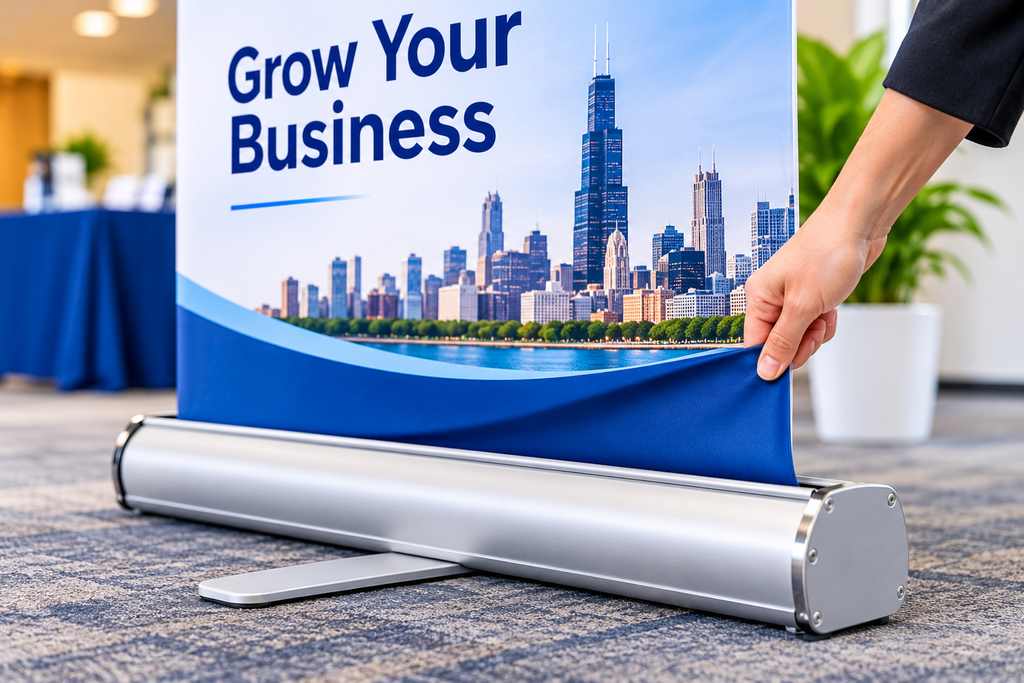
That design explains most of its strengths and its drawbacks:
- Fast setup. Suppliers commonly describe setup as taking about a minute, without tools.
- Graphic protection. Because the print retracts into the base, it is shielded while you travel and store it.
- Replaceable graphics. On many models you can replace just the cartridge and keep the base, so only the message changes.
- Weight. The base, roller and pole add weight compared with a frame, so a retractable stand is heavier to carry, though it travels in a padded carry bag.
- Higher upfront cost. More hardware means a higher entry price than an X-frame.
On our own banners page, Zee Signs Chicago lists retractable banners as a kit that includes the stand, the banner and a travel bag, with single-sided and double-sided printing available. The page describes them as suited to trade shows, conferences and promoting new products at a retail store.
When an X-frame stand is the smarter choice
An X-frame stand, sometimes sold as an X banner stand, is a pair of lightweight rods that cross to form an X. Grommets at the four corners of the banner hook over the ends of the rods, so the print is on display the entire time. Suppliers commonly list it among the lightest options, and the frame folds flat.
That simplicity makes an X-frame a sensible choice in a few situations:
- A short campaign. If you are running a seasonal offer and will not use the display again, the lower upfront price matters more than long-term durability.
- Many locations at once. A set of inexpensive stands can go to several branches or booths.
- Frequent graphic changes. Because the graphic is separate from the frame, you can reprint it without replacing the hardware.
The trade-offs are the mirror image of the retractable stand. The graphic is exposed when stored, tension can take a moment to even out, and the light frame is easier to knock over in a draft. Suppliers generally recommend keeping X-frame stands indoors and away from drafts.
Where a tension fabric stand fits
A tension fabric banner stand stretches a fabric graphic over a lightweight aluminum frame. Suppliers describe the fabric graphic, often a sleeve that slides over the frame, as washable and reusable, with a smooth, wrinkle-free finish. Because the frame can be built in larger widths, this is the format businesses use for event backdrops, booth walls and branded photo areas.
It is usually the most expensive of the three. It is also the one that most resembles a wall of branding rather than a single banner. If your goal is a photo backdrop or a full booth wall, it is worth the comparison. If you need a single message beside a reception desk, a retractable stand is typically a better fit.
Banner stand sizes: what to expect
Size is one of the most common questions behind the search for banner stand sizes, and ranges differ by supplier. As an approximate guide, retractable stands are commonly offered from about 24 inches wide up to nearly 60 inches wide, with heights around 80 inches; the roll-up format most people picture is roughly 33 by 80 inches (width by height). X-frame stands are generally smaller, with typical sizes running from about 24 by 60 inches to 48 by 78 inches.
A practical way to choose the size:
- Narrow and tall (about 24 to 33 inches wide) suits tight spaces such as a retail counter, a hallway or the side of a registration table.
- Wider formats give more room for a headline, a logo and a short list of services, but need more floor space and a more stable base.
- Place the key message in the upper two-thirds. The lowest part of a tall banner is often hidden behind tables, chairs and people.
Always confirm the printed dimensions of the stand you are buying, because the visible graphic area can be smaller than the stated banner size once it sits in the base.
Indoors, outdoors and wind
Retractable and X-frame stands are designed mainly for indoor use. Suppliers generally advise keeping X-frame stands indoors and away from drafts, and say that outdoor use calls for weighted bases or anchoring. If you plan to display a banner outside a storefront or at a street-level event, you should plan for wind.
For an outdoor setting, ask whether a different format is a better fit. Our vinyl and mesh banners, for example, are made for outdoor applications with hanging options such as grommets or pole pockets. If you are comparing outdoor banner materials, our guide to the different types of banners explains how vinyl, fabric and mesh differ.
Cost and long-term value
Published starting prices vary by supplier, size and finish, so treat any figure as a snapshot. As a rough and approximate pattern, supplier price lists show entry-level retractable stands starting at around $140 and X-frame stands at roughly $90 to $100, and the figures are not always consistent from page to page. These are supplier figures, not Zee Signs Chicago prices, so confirm any price at the time you order.
The pattern holds across suppliers:
- X-frame: lower upfront cost, with inexpensive graphic reprints, but less suited to years of heavy repeat use.
- Retractable: higher upfront cost, longer service life when used often, and a protected graphic.
- Tension fabric: typically the highest price, justified by the size and presence of the display.
If you will use a display five or ten times, the retractable stand often costs less per event than replacing a frame and graphic each time. If you will use it once, it rarely does.
A simple way to choose
Answer these four questions and the choice usually becomes clear:
- How many times will you use it? Once or twice points to an X-frame; many times points to a retractable stand.
- Where will it stand? Indoors in a lobby or booth suits either; a backdrop or wall calls for tension fabric.
- How will you move it? If it has to travel by car or in a bag, weight and a carry case matter.
- Will the message change? If it will, look for replaceable graphics.
Keep your artwork simple. A short headline, a clear logo and one call to action read better on a tall, narrow banner than a full page of text.
Next step
If you are weighing a retractable banner stand for an event, a lobby or a retail counter, send us the dimensions you have in mind and where it will be used. The team at Zee Signs Chicago can help you choose a size and a print option, and you can start from our banners page or request a quote.
FAQs
A retractable stand winds the banner into a weighted base and raises it with a telescoping pole, which protects the graphic. An X-frame holds a banner on crossed rods by its four corners. The X-frame is lighter and cheaper up front; the retractable stand is sturdier for repeated use.
A common roll-up format measures roughly 33 inches across and 80 inches high. Ranges vary by supplier, from about 24 inches wide up to nearly 60 inches wide. Check the exact printed area of the stand you choose before designing your artwork.
Most retractable and X-frame stands are built for indoor use, and lightweight frames are less stable in a draft. For outdoor promotion, ask about a weighted base or consider a vinyl or mesh banner designed for outdoor hanging. Wind is the main limitation.
Often yes. On many retractable models you can replace just the cartridge, and an X-frame graphic is separate from the frame, so you can reprint the message without buying new hardware. Confirm that the replacement graphic is available for the model you buy.
Suppliers say no tools are needed and the whole job takes roughly a minute: pull the graphic up out of the base and fit the pole at the back. An X-frame is quicker still, plus a little time to even out the tension. Allow extra time on the day to check that the graphic hangs straight and the base sits level.